Architecture
Platform Overview
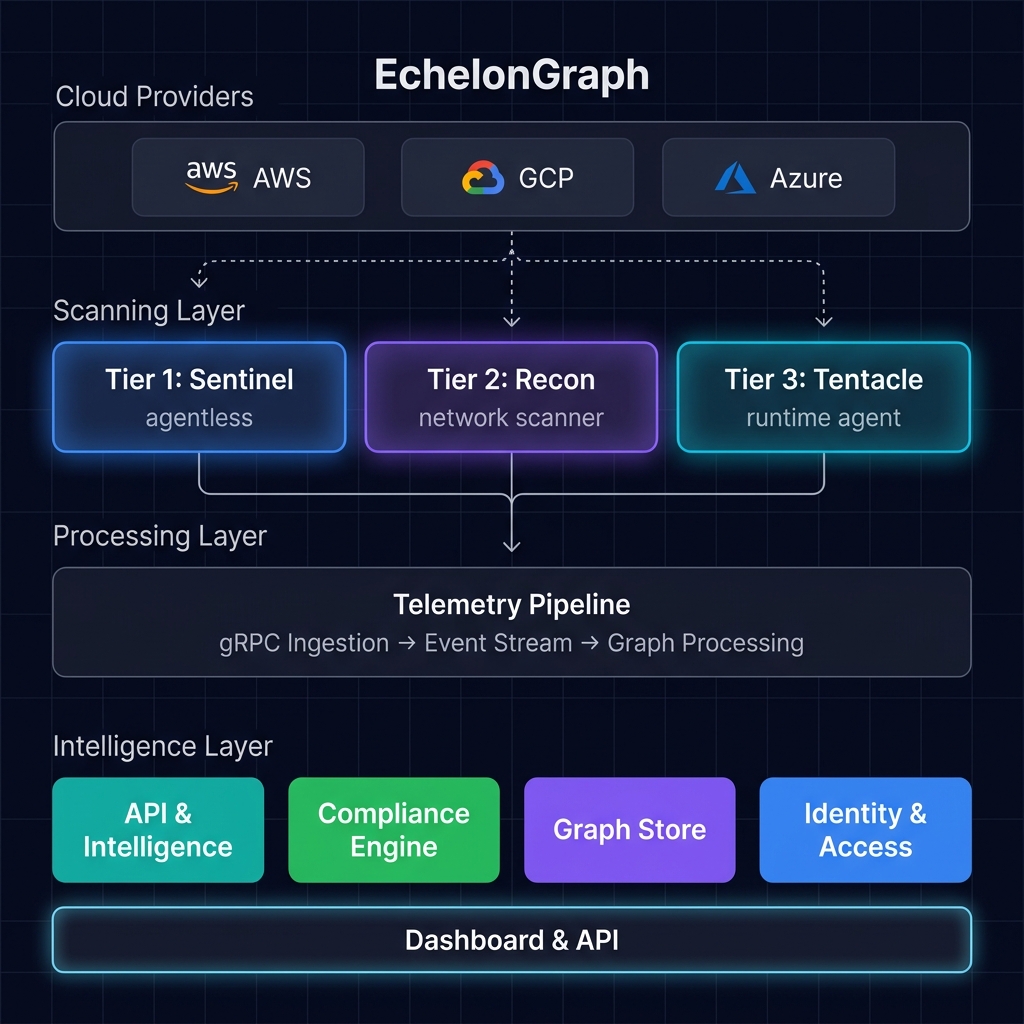
EchelonGraph is a cloud-native security platform built on a microservices architecture designed for multi-tenant isolation, horizontal scalability, and real-time threat detection. The platform processes cloud telemetry through a high-throughput event pipeline and presents results through interactive dashboards and a comprehensive REST API.
Core Services
The platform is composed of purpose-built services, each responsible for a distinct domain:
- API & Intelligence Layer: Serves the REST API, computes blast radius analysis, processes CVE feeds, and calculates risk scores
- Identity & Access: Handles all authentication (SSO, MFA, WebAuthn), role-based access control, SCIM 2.0 provisioning, and session management
- Compliance Engine: Continuously evaluates infrastructure against 300+ compliance frameworks with 3,000+ automated controls
- Telemetry Pipeline: High-throughput ingestion and processing of scan results, delivering findings to dashboards in real-time
- Scanning Layer: Multi-tier scanning — agentless cloud API scanning, network-level discovery, and runtime telemetry collection
- Product Frontend: Interactive dashboards, 3D blast radius visualization, alert management, and compliance reporting
Data Flow
The scan-to-dashboard pipeline is fully automated — no manual data insertion at any stage:
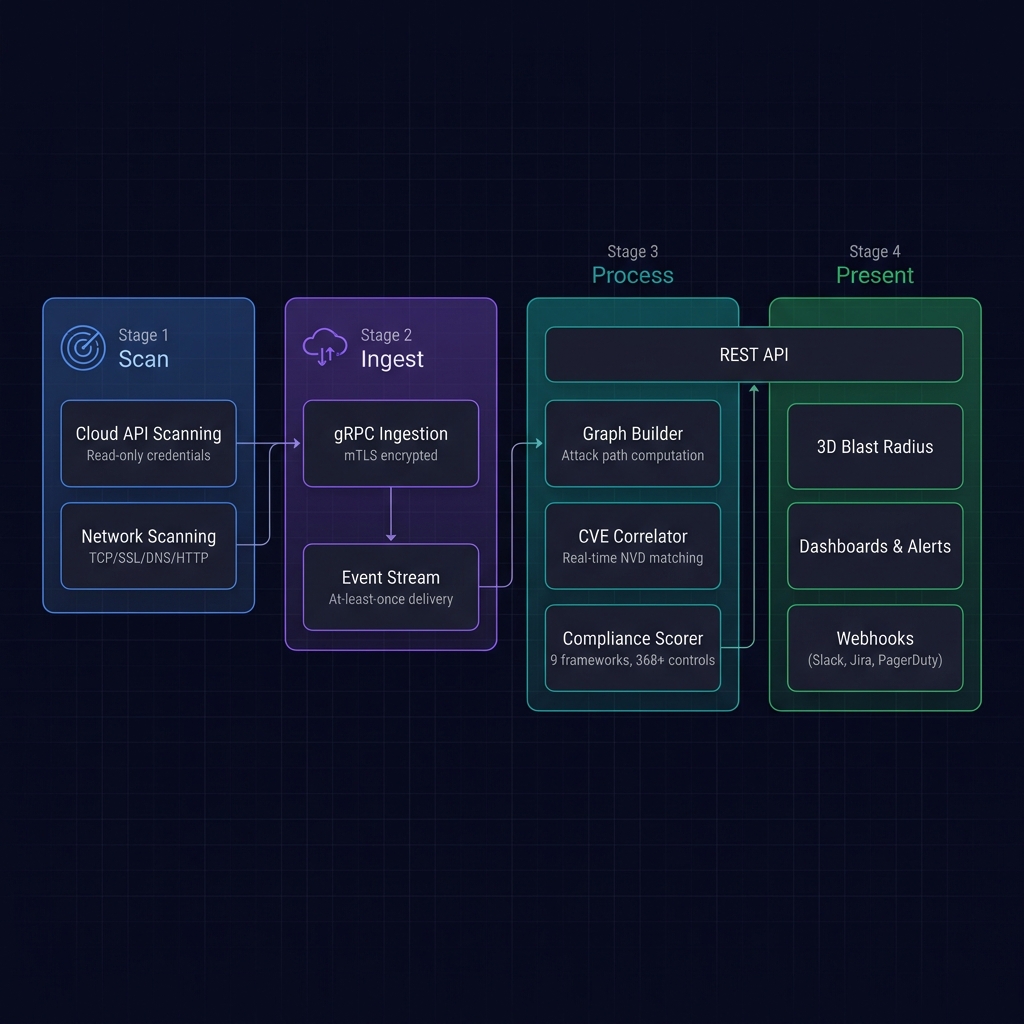
- Scanners authenticate with your cloud provider APIs using read-only credentials
- Scanners discover assets and run 440+ misconfiguration rules mapped to CIS v2.0
- Scanners correlate CVEs and build attack path graphs from internet-facing nodes inward
- Findings are ingested through a high-throughput gRPC pipeline with at-least-once delivery
- Findings are processed — graph builder computes attack paths, CVE correlator matches against NVD, compliance scorer evaluates 300+ frameworks
- The API layer queries processed data and serves it to dashboards and integrations
- Dashboards update with 3D graphs, alerts, compliance scores, and webhook notifications in real-time
Tenant Isolation
Every customer's data is completely isolated at every layer of the platform. Cross-tenant access is architecturally impossible — not just restricted by application logic, but enforced at the data layer itself.
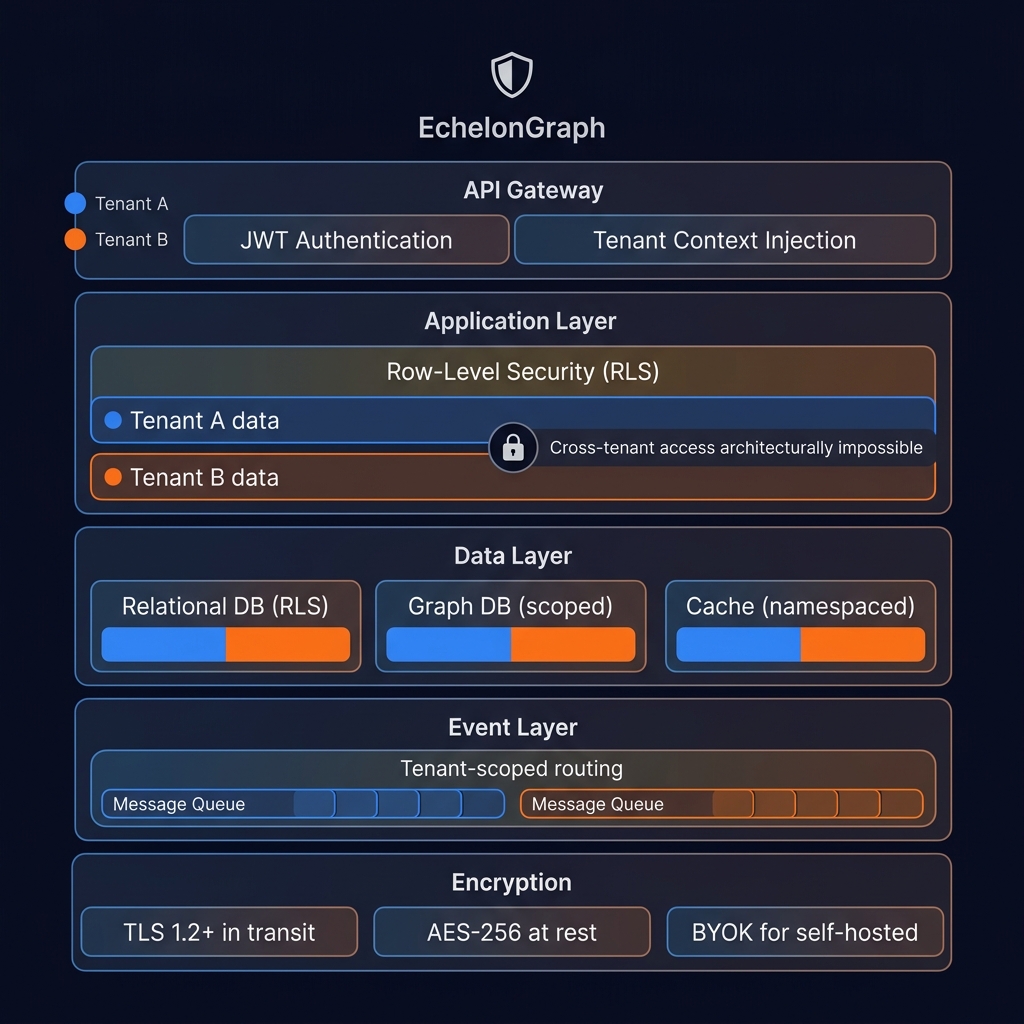
- Relational data: Row-level security policies ensure queries can only access the authenticated tenant's rows
- Graph data: Every node carries a tenant identifier with enforced scoping on all queries
- Analytics data: Partitioned by tenant for physical separation at the storage layer
- Caching layer: Namespaced per-tenant with no cross-tenant access possible
- Event bus: Tenant-scoped routing ensures consumers only receive their own events
Performance
The platform is engineered for sub-second response times under production load:
- Blast radius queries return in milliseconds, even for complex multi-hop traversals
- Telemetry ingestion handles hundreds of events per second per instance with automatic horizontal scaling
- Alert delivery reaches connected dashboards in under 100ms
- Frontend loads in under a second with optimized asset delivery
All services scale horizontally to meet demand, with built-in circuit breakers and retry logic to maintain availability during upstream issues.
Encryption
Data is protected at every layer:
| Layer | Protection |
|---|---|
| In transit | TLS 1.2+ on all connections |
| At rest (infrastructure) | AES-256 encryption on all managed data stores |
| At rest (sensitive data) | Field-level encryption for credentials and personally identifiable information |
| Password storage | Industry-standard hashing with constant-time comparison |
| Secrets management | Versioned, audit-logged, and auto-rotatable secret storage |
| Self-hosted | Bring Your Own Key (BYOK) — customer-managed encryption keys |
High Availability
- Auto-scaling: Services scale horizontally based on demand with warm-instance support to eliminate cold starts
- Automated backups: Daily backups with point-in-time recovery for all critical data
- Event durability: At-least-once delivery guarantees for all scan results and alerts
- Circuit breakers: Automatic failure isolation with exponential backoff retry
- Health monitoring: Continuous liveness and readiness checks on every service